
The Average Gamer Is Dead... or Is It?
I've spent the last few days going through Bain & Company's Gaming Report 2026: Choose Your Player. Bain split its 2026 report into four pieces: a player survey, a piece on focus versus scope, one on personalisation, and one on direct distribution. When read separately, they look like four different topics — but actually they are one argument: the game industry's old growth formula is broken, and the companies replacing it are all doing the same four things, in the same order.
It's a clean argument but a few of the numbers underneath it are doing more rhetorical work than analytical work — and one section, the one on direct distribution, has a hole in it big enough that I want to walk through the math. So here's the report, section by section, with what I'd push back on after each one.
1. Demand didn't shrink. It shattered.

Let's start with the numbers that got my attention first. Bain surveyed 5,339 players in June 2026 and asked what kind of game experience they actually want. The answers split almost evenly into five buckets: professionally-crafted story games, open sandbox/UGC experiences, mood-dependent picks, competitive multiplayer, and everything else. None of them cleared 26% of respondents.
But the subplot is more interesting. These preferences aren't randomly distributed — they are sharply age-coded. Sandbox and user-generated content pulls 32% of 13–17 year-olds and drops to roughly 15% or lower among players over 50. Monthly spending follows the same curve in reverse. 86% of teenage players spend something every month, compared to 51% of players in their 50s, 36% in their 60s, and 27% for players 70 and older.
Spending itself is brutally concentrated. The most active 20% of players account for 59% of all playtime. The top-spending 20% account for 73% of all spend. Players who create content are twice as likely to be consistent spenders as players who don't.
“Reach everyone” is no longer a strategy — it's a tax.
Every dollar spent chasing the median player is a dollar not spent on the 20% who actually fund the business. The strategic question has shifted from “how do we reach more players?” to “which players are we choosing, and how completely do we own that relationship?”
The framing here is more dramatic than the underlying reality. A segment that's “only” 22–26% of a market worth $202 billion is still worth tens of billions of dollars. That's bigger than most entire national game markets were a decade ago. The real story isn't “you can no longer build something huge.” It's “the market got so huge that a well-defined 22% slice is now big enough to be a AAA business on its own.” That changes the takeaway from “narrow your ambition” to “narrow your targeting, not your ambition.”
2. Focus beats budget (and AI doesn't change that)

If demand has fractured, the natural instinct is to build and cover more genres, more playstyles, more audiences — especially now that AI tooling makes production cheaper. The second section of the Bain report essentially serves as a response to this instinct, and it's the report's most concrete part.
Bain analysed 100 games released since 2023 and found that titles built around a clearly-defined player hit commercial success 83% of the time. Titles built without that clarity — designed to appeal broadly, or chasing a market rather than a player — succeeded only 50% of the time. That's not a marginal edge.
Here's the part that made me pause: Bain found that 66% of players actually want sequels or close variations on games they already love. Only 21% are actively seeking something genuinely new. Among surveyed players, 42% say they are more comfortable with AI in games now than a year ago, so the appetite is there — but only for studios that already know what they are building. Bain's phrase for this, which I think is the best line in the entire report, is that “AI is an accelerant, not a rescue” — because it compresses the timeline for studios with a clear target player. For studios without one, it just lets them scale the wrong bet faster.
The 83%/50% split is doing a lot of work for a stat that's probably confounded. Studios disciplined enough to define their player clearly are very likely also the studios with better greenlighting processes, stronger creative leadership, and tighter budget control. So the causal claim is plausible but not demonstrated — it's just as consistent with “well-run studios succeed at everything, including focus.” I'd also push on the “AI is an accelerant, not a rescue” line. It's a great line precisely because it's unfalsifiable. It tells you nothing about what actually changes: headcount, outsourcing, tooling budgets, production timelines. It's the kind of sentence that's true regardless of what AI does, which makes it more marketing than insight.
3. Once you've chosen your player, you have to actually know them
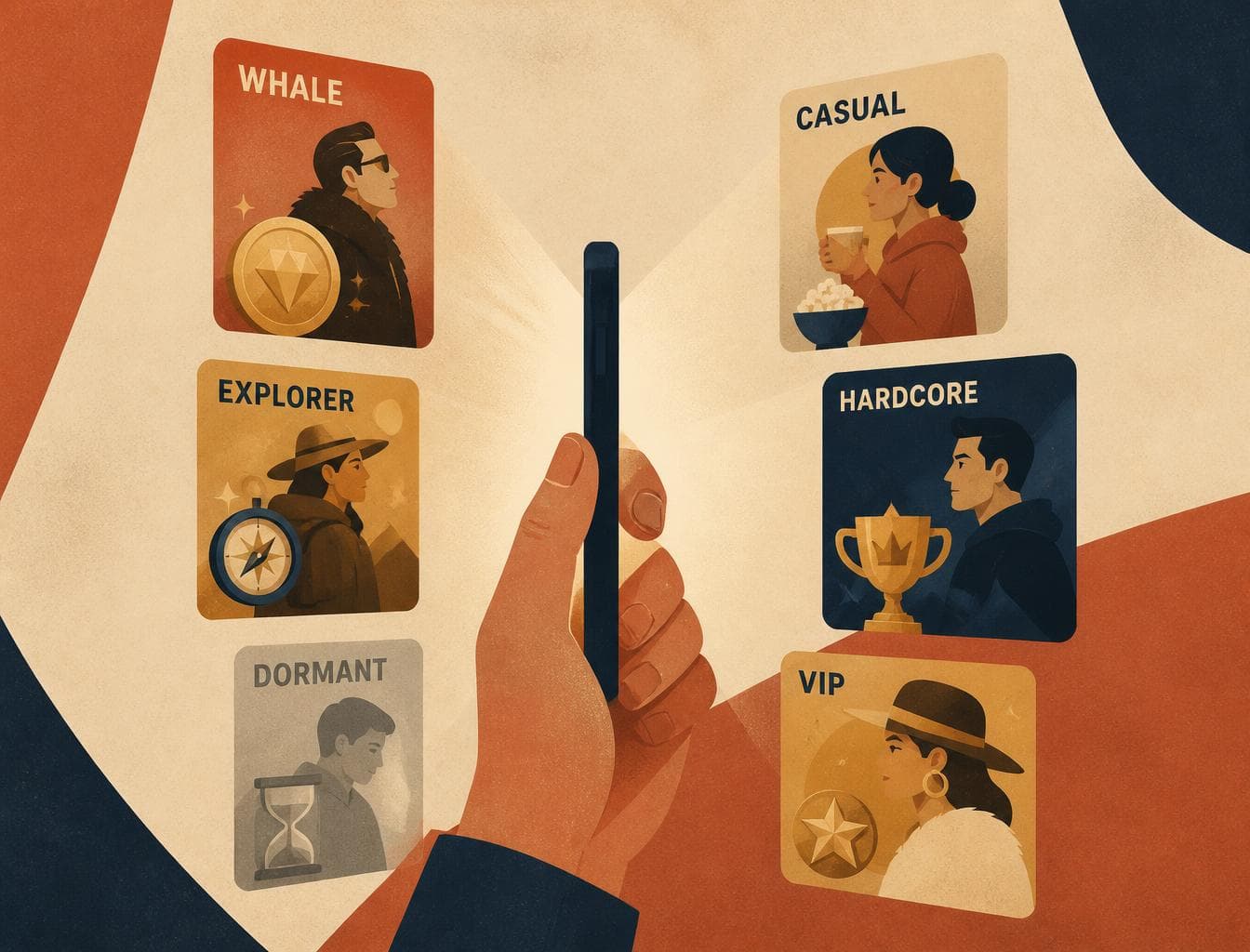
Sections one and two establish who to build for. Section three is about what you do once you have them. It's arguably the most immediately actionable part of the report for anyone running LiveOps or CRM today.
Global gaming software revenue grew from $131 billion in 2019 to $202 billion in 2025, and Bain projects similar ~3% growth through 2029 reaching $232 billion. That's healthy, but it's a fraction of the growth rates the industry got used to a decade ago. The implication is uncomfortable but can't be avoided: you can't out-acquire your way to growth anymore. The next lever is not more players. It's getting more value out of the players you already have by understanding them better than anyone else can.
Bain cites a case built with Braze where a free-to-play publisher moved from static, broad promotions to real-time offers matched to individual player behaviour — testing thousands of trigger-offer combinations and serving whichever one had the highest predicted conversion for that specific player at that specific moment. Per-player revenue from that live-ops campaign increased by more than 50%.
Bain lays out five places to apply personalisation:
- In-game store optimisation and dynamic pricing
- Lapsed-player win-back campaigns
- Personalised onboarding
- In-game content discovery
- Cross-title recommendations for publishers with multiple games
Their advice on sequencing: define your metric before you start, staff it cross-functionally rather than burying it inside marketing, partner rather than build the orchestration layer from scratch — and don't wait for perfect. Early movers aren't just getting a capability, they are building a data flywheel competitors can't easily copy.
That Braze case study is a vendor testimonial dressed as a data point. No publisher name, no control group, no baseline, no timeframe. It's Braze's own client story, cited in a report where Braze's VP is also directly quoted. That doesn't make it false, but “more than 50%” should be read the way you'd read any vendor's own case study: real, probably cherry-picked, and not necessarily typical. The bigger gap is that the report frames personalisation as almost purely upside. What's missing is the backlash case: individualised dynamic pricing has a well-documented ick factor once players notice it. Being comfortable with personalisation in the abstract and being comfortable when you find out a friend got a cheaper offer than you are two different surveys, and Bain only ran the first one.
4. Stop renting the relationship
Nearly half of all players (47%) bought something directly from a developer's own web store in the past 12 months, and 27% are repeat direct buyers. Awareness isn't the bottleneck — 83% of players know direct purchase options exist. Direct-to-consumer purchases now represent roughly 15% of mobile in-game spending, worth close to $17 billion in 2025, and for companies like Modern Times Group and Playtika, direct sales grew from 25% to 40% of total revenue in a single year.
What's new is that the platform economics finally moved. Google agreed to cut its standard cut from 30% to 20%, and as low as 15% under certain conditions. The EU's Digital Markets Act forced alternative storefronts open. A US court ruling pushed Apple to allow external payment links. And here's where section four loops back and closes the argument: discounting alone doesn't work. Bain found that raising a bonus from 10% to 30% barely moved purchase behaviour. What did move behaviour was personalisation. 84% of repeat direct buyers said a personalised offer from a game they play would make them more likely to buy, and direct buyers were roughly twice as receptive to personalised offers.
This is the one I feel strongest about. Bain's urgency here skips the actual unit economics — and once you run them, “just switch to a web store” stops being obviously true. I came across a breakdown from Deconstructor of Fun that ran the math precisely, and it's worth walking through.
Take a mid-core studio doing $3M/month in EU iOS revenue, all through Apple IAP at the old 30% rate. Do nothing, and the new post-settlement rate drops to 26%. That's worth $120K/month — about $1.4M/year for zero engineering work.
Now the web store math. Apple's off-platform fee is 15%, payment processing takes another ~3.5%, so you keep about 81.5% of whatever revenue survives checkout. But not everyone survives checkout — leaving the app for a browser costs conversion at every step. Assume a fairly generous 70% of demand makes it through that handoff: $3M × 70% × 81.5% ≈ $1.71M net. Compare that to $2.22M from doing nothing at the new 26% rate. Switching just cost you roughly half a million dollars a month, before counting engineering time. Run the math backward and you need something close to 90% checkout conversion just to break even with doing nothing.
This doesn't mean Bain is wrong that direct distribution is real and growing — the Fortnite-scale cases clearly clear that conversion bar, and the math works great for them. But the report's “every quarter of delay is expensive, move now” urgency is calibrated to those outliers, not to the median mid-core studio it's ostensibly advising. For most publishers, the smarter first move might just be pocketing the new lower platform fee and waiting for checkout conversion tooling to mature before building a storefront that, on current numbers, likely loses money.
Where this leaves me
Strip away the parts I'd push back on and the report's structural insight still holds: fragmentation forces focus, focus enables personalisation, personalisation is what makes direct distribution pay off rather than just relocate a fee. That sequencing logic is sound.
What I don't buy is the uniform urgency applied to all four moves regardless of studio size or audience shape. Fragmentation is real but the addressable slices are still enormous. Focus correlates with success but probably isn't the sole cause of it. Personalisation's upside is likely overstated by a vendor case study, and its downside risk goes unmentioned. And direct distribution, on the actual unit economics, is a move that pays off for outliers and quietly loses money for the median studio the report is nominally written for.
The report's title is “choose your player.” My addition would be: choose your player, and then run your own numbers before you choose which of these four moves is actually yours to make.
Source: Bain & Company — Gaming Report 2026: Choose Your Player